
The Northumberland County Owner of Record
ConciseCAMA is the county-linked place to view the assessment owner field. A selected parcel card there can display the address, map number, values, legal description, and sale details. It also shows the owner's name. Field labels vary by record, so read what is shown for each parcel. Keep the displayed date together with the owner's exact name when you copy the entry.
| Owner line | Exact name or names shown in the current roll result |
|---|---|
| Mailing address | Tax-mail destination, which may differ from the parcel |
| Situs | Property location as displayed by the system |
| Map number | Assessment key for matching the parcel across offices |
| Assessment date | Date stated for the ownership and assessment snapshot |
| Deed reference | May be listed; confirm the transfer in the Clerk's index |
The assessment owner is simply the party named for tax-roll purposes. A mailing line may point to an entity, a fiduciary, or an owner living elsewhere. It proves nothing about occupancy. When several people or an organization appear, copy the names exactly as displayed, then use the deed records to see how title is held.
Northumberland County's Dated Ownership Snapshot
ConciseCAMA dates its ownership and assessment information to December 31, 2025. The portal separately posts a last-updated date of September 12, 2026. These two dates describe different facts. A later refresh line does not mean a deed recorded after the effective date has reached the owner field. A refresh can post later without the owner field changing.
Keep both dates in mind. Ask the Commissioner about update timing when a recent transfer matters. The notice states that official records at the Commissioner's office remain authoritative. The site presents its data as is.
The CAMA disclaimer appears before the property search.
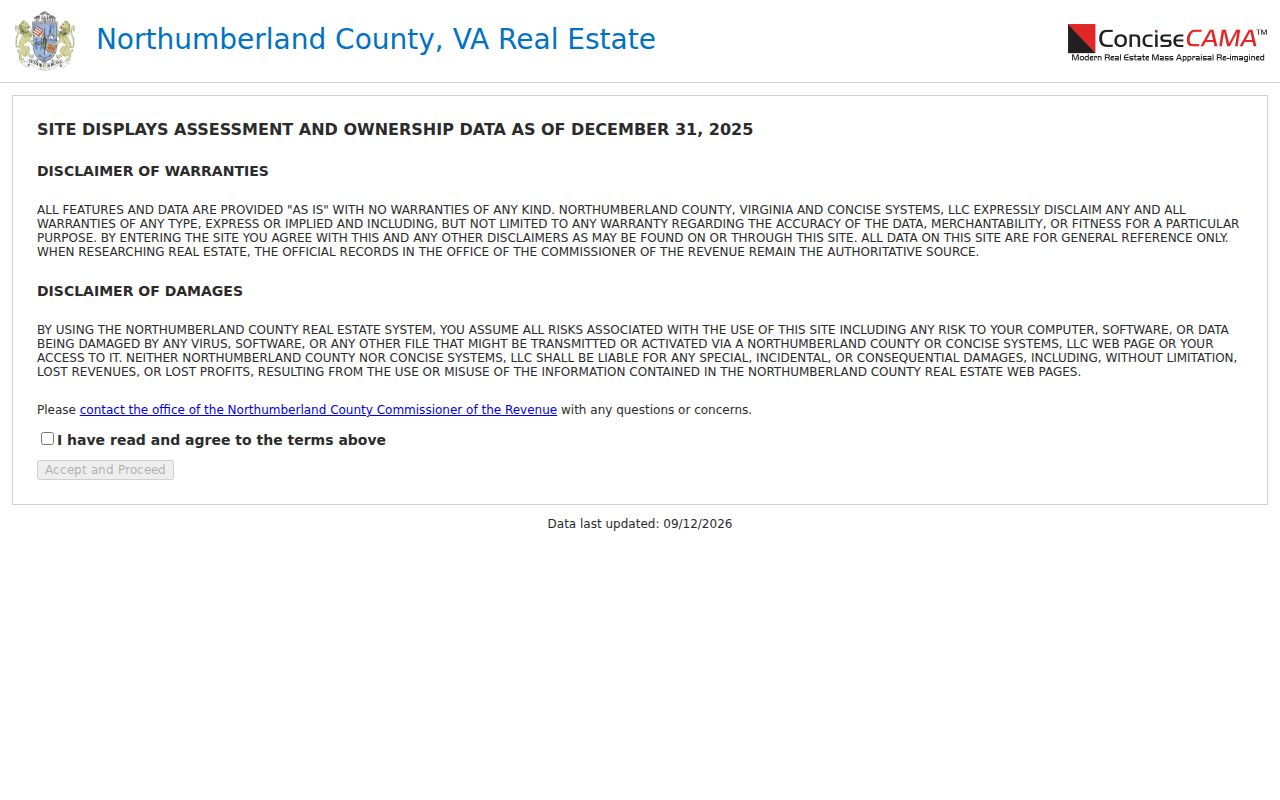
Note: Check both dates before treating an owner line as current for a newly transferred parcel.
How Current Is a Northumberland Owner Entry?
CAMA publishes no routine update interval for its owner field. The stated ownership snapshot and the separate refresh line are the only timing clues. Closing, recordation, and assessment updates are three distinct events. A record can be current as of its own effective date. A newer deed may already sit in the deed records. For a recent sale, pull the Clerk's newest recorded deed. Compare its grantee and parcel description with the CAMA owner line. If they differ, ask the Commissioner whether the assessment record has caught up. Never guess how many days a transfer takes to appear.
Keep three dates separate. One is the deed's recordation date. Another is the effective date printed for the ownership data. The third is the date you viewed the portal. The last shows only when you checked. A new refresh line does not prove every earlier recorded deed has been matched to its parcel.
The newest deed may not even be an outright conveyance. A deed of trust, release, easement, correction, or fiduciary filing can concern the parcel without moving ownership. Read the instrument type and legal description first. A Northumberland County owner search should end with a document check. If the roll still differs, ask the Commissioner rather than assuming an update schedule.
Confirming the Current Northumberland Owner
Use the tax roll to locate the parcel. Then check the recorded deed for the latest conveyance. Compare the owner name, map number, legal description, and recording date. The full chain of title is not the goal here. The aim is to verify which deed is newest. It also confirms whether the roll has caught up to it.
- Search the parcel in ConciseCAMA and copy the owner line and stated assessment date.
- Use the map number or legal description to match the latest deed in SRA.
- Check the deed's grantee, recording date and property description against the roll.
- Ask the Commissioner to explain a discrepancy or a recent-sale gap.
Long deed descriptions demand close reading. Match the owner's name alone and you can go wrong. Compare every lot and acreage figure instead. Check each adjoining call and any referenced plat. One transfer may cover part of a larger tract, several parcels, or an undivided interest. A newer recording date helps only after you confirm the instrument concerns the same land. It must also actually convey the interest being checked.
- Owner of record
- The party named in the assessment roll or recorded conveyance.
- Assessment roll
- The Commissioner's real-estate ownership and value record.
- Situs
- The parcel's location, separate from a mailing destination.
- Recording lag
- The period between a recorded deed and a later roll update; Northumberland's routine interval was not established.
Northumberland Situs and Mailing Fields
A situs address identifies the land itself. A mailing address directs tax correspondence. It may belong to an out-of-county owner, an attorney, a trust, an LLC, or a fiduciary. That distinction matters most when two owners share a name. It also matters when a tract carries a rural road number plus a separate postal place. Use the mailing line only for a lawful property matter. It shows neither who occupies the site nor where a person lives. Compare it against the map number. Compare it against the deed legal description too, instead of treating it as an identity check.
Rural records complicate things further. The situs may appear as a 911 road address. Meanwhile the tax mail goes to a post-office box in another community. One mailing address can serve several parcels. A parcel's tax bill may go to an agent rather than the named owner. Keep each address tied to its field label. Then use the map number plus deed description to confirm the record matches the land you are researching.
Entity Names in the Northumberland Owner Field
The owner of record is not always a person. Northumberland rolls often carry an LLC. They also carry a corporation, a trust, or an executor acting for an estate. Match the wording in the CAMA field to the exact language on the recorded deed. That instrument, not a database entry, controls vesting.
An entity search can still add context. Virginia SCC CIS publishes public filings for corporations and LLCs registered in the state. Use it to learn what the organization is. Do not treat it as proof of beneficial ownership. A registered office address does not show that anyone lives on the parcel either.
When a fiduciary holds title, the probate order explains the authority. The resulting deed may name the executor or administrator and how they can convey. The Circuit Clerk keeps public will and fiduciary records for Northumberland County. Pull the land instrument when the question is who truly owns the parcel.
Northumberland Clerk Copy and Certification
Copies come from the Clerk of Circuit Court. Deeds, plats, and other court records are public. Bring the right identifier first. For a land record, that means deed book and page or the instrument number. A plat needs its book or cabinet and slide. The office sits at 220 Judicial Place in Heathsville, and 804-580-3700 reaches staff who can help locate land records and fiduciary files.
No flat copy fee is posted locally. Ask the office whether a plain or certified copy fits your need and what each costs. Virginia Code §17.1-208 guarantees inspection and copies of clerk records unless another rule restricts them. The Clerk's copy-request instructions list the details to gather before you call.
Northumberland Owner Is Not Occupant
An owner field answers one question only. It names who appears in the Northumberland County deed or assessment record. It does not say who lives on the land or uses a building. Mailing addresses can sit far from the situs, and title may rest with an entity or a fiduciary. Never present a tax address as someone's current home address.
Virginia runs an Address Confidentiality Program that gives eligible protected participants a substitute address. Honor those protections. Keep a property search tied to the parcel and a lawful purpose such as estate work or civic research. The owner detail page confirms none of it. Not possession, not identity, not daily routines. The Virginia Attorney General's ACP page explains the program.
Limits on a Northumberland Owner Lookup
A Northumberland County owner lookup is a records check, nothing more. Public data can be incomplete, stale, or shielded by a confidentiality rule. Verify any deed or tax roll entry with its custodian. Keep the inquiry anchored to the parcel and a lawful property purpose.
Lawful use. Use Northumberland County records for property diligence, boundaries and civic purposes. Do not use a name or mailing address to stalk, threaten or harass anyone.